Identity Map Summary
A visual overview of your strengths, recurring themes and core contradictions, all on one page.
Lumio maps your strengths, experiences and patterns into a structured clarity report. So you can stop running in circles.
Scroll to turn the pages ↓
Inside the report
You are not lost.
You are unstructured.
How it works
Journals hand you questions and leave you alone with the answers. Lumio reads what you wrote and writes back.
29 questions designed to make you actually think. Not “what are your strengths”, but the ones that pull out the patterns you don't see yourself.
Your answers are mapped, clustered and pattern-checked. Strengths, contradictions and blind spots, all surfaced through a defined methodology.
A 20-page PDF mapping your strengths, your blind spots and 3 specific possible directions. Followed by an optional 30-minute walkthrough call.
What you get
Plus a one-page mind map, and a closing letter that hands it back to you.
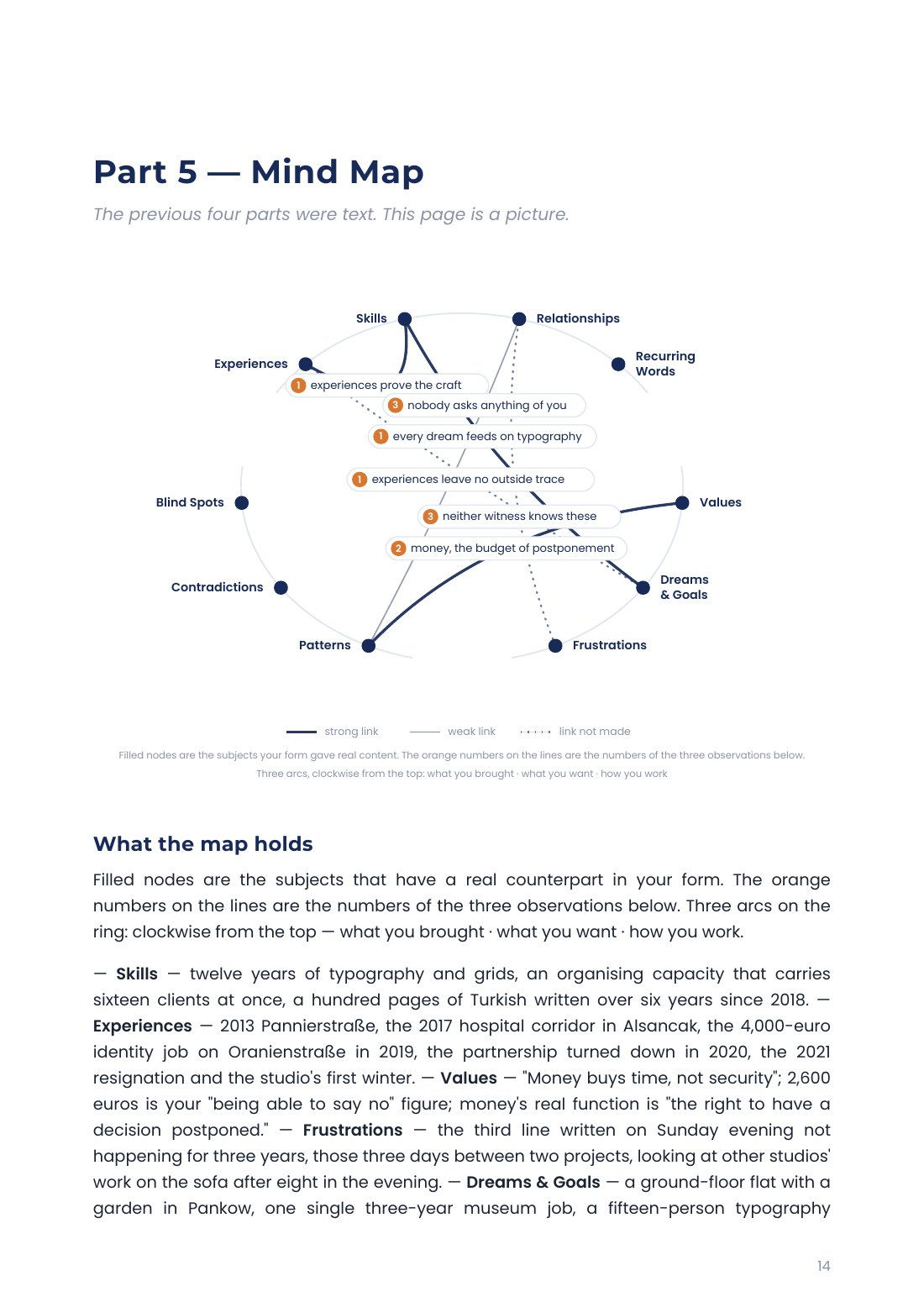
A visual overview of your strengths, recurring themes and core contradictions, all on one page.
What actually repeats across every area of your life. Not what you say you're good at. What your patterns prove.
Where internal conflict is creating inaction. Why you start things and don't finish them, and what's actually underneath.
2–3 specific things you keep missing or dismissing. The section most people don't want to read and need to read most.
3 specific possible paths (career, project or life) with reasoning grounded in your own answers.
3–5 concrete next steps tailored to your situation. Things you can start tomorrow without more information.
Page 14
Ten things you brought, wanted and work around, drawn as one figure. A solid line is a connection your answers already make. A dotted line is one that isn't there yet, which is usually the more useful half.
Our methodology
Three established bodies of work, each answering a different question. Open the one you want.
Dan P. McAdams, Northwestern University
Ask someone who they are and they tell you a story.
McAdams's claim is that the story is not a description of identity. It is identity: a reconstructed past, a perceived present and an anticipated future bound into something that feels like one person.
Which means it can be re-authored. “I am someone who avoids decisions” and “I am someone early in the practice of deciding” fit exactly the same evidence, and they allow very different next moves.
There is a second thing worth knowing. This story is still being written through your twenties and into your thirties. If you are 28 and yours does not feel settled, you are not behind. You are in the middle of writing it.
The 29 questions are a written adaptation of his Life Story Interview.
The research coding. You will never see a score, a percentile or a level.
McAdams, The Stories We Live By (1993) · McAdams & McLean, “Narrative Identity”, Current Directions in Psychological Science
Richard C. Schwartz, Harvard Medical School
Every part of you, including the one doing visible damage, is protecting you from something.
You are not one unified self. You contain parts, each with its own perspective and its own job. The procrastinator guards you against the shame of producing something inadequate. The inner critic tries to make you acceptable before anyone else gets the chance to reject you.
Two of those protectors can end up fighting each other over the same wound. The part that drives you relentlessly and the part that stalls you are not discipline against laziness; they are two strategies aimed at the same thing, locked against one another. The tiredness you cannot account for is the cost of that.
This is where Lumio's tone comes from. A report says “this pattern's job is to protect you from the feeling of loss”, never “you are avoidant”. The first invites recognition. The second invites defence.
The language and the stance: every pattern named by what it protects against.
The therapy itself. No clinical work happens here, and that boundary is in every report.
Schwartz, No Bad Parts (2021). IFS was listed as an evidence-based practice on the US federal registry in 2015; that registry closed in 2018, and the evidence base is still thinner than CBT's, which IFS practitioners say themselves.
Bill Burnett & Dave Evans, Stanford Life Design Lab
There is no right life. There are lots of good ones.
Most advice treats “what should I do with my life?” as a problem with one correct answer, discoverable by thinking hard enough. Burnett and Evans treat it as a design problem: no single right answer, and no way to know whether one works until you have partly lived it.
So the question stops being “what should I do?” and becomes “what versions of my life are actually possible?” That is why your report ends with three paths and no recommendation.
It is also why the last part asks for small, cheap experiments instead of a five-year commitment. An experiment that fails has worked, as long as it told you something you did not already know.
Three paths rather than one answer, and prototypes rather than plans.
The workshop, the journal and the group. If you want the full method, the book is cheap and excellent.
Burnett & Evans, Designing Your Life (2016) · the Odyssey Plan, taught at Stanford for close to twenty years and now supported at 600+ universities
What I should also say
Lumio itself has not been studied. The ideas underneath it are well founded: four decades of peer-reviewed personality psychology, a method taught at Stanford for nearly twenty years, a therapeutic model taught at Harvard Medical School. The specific service is new.
I'd rather tell you that than let you find it out. Lumio is not therapy, not coaching and not an assessment. It is structured self-reflection, and it stays inside career and identity.
Choose your report
Beta price, first 30 clients.
€89 after that.
Everything in the report,
plus the conversation.
The button you choose sets the language of your report. Payment is handled securely by Stripe. Full refund before you submit the intake form.

About
I'm Tufan.
My life moves between two countries, Turkey and Germany. Two cities. Two ways of living. Three languages I think in, sometimes all at once.
For the last five years, I've worked in places where I meet hundreds of people every week. Different jobs, different ages, different stories. I listened to a lot of them, more than they probably realised.
And after a while, I started seeing the same thing happen again and again. Capable people who were not short of information about themselves. What they were missing was a way to see how the pieces they already had connected.
That's what Lumio is. It started as something I built for myself. Then for a few people I knew. Now it's a method.
It's not therapy. It's not coaching. It's not motivation. It's a way to finally see where you already stand.
If you read this far, you probably already know if this is for you.
FAQ